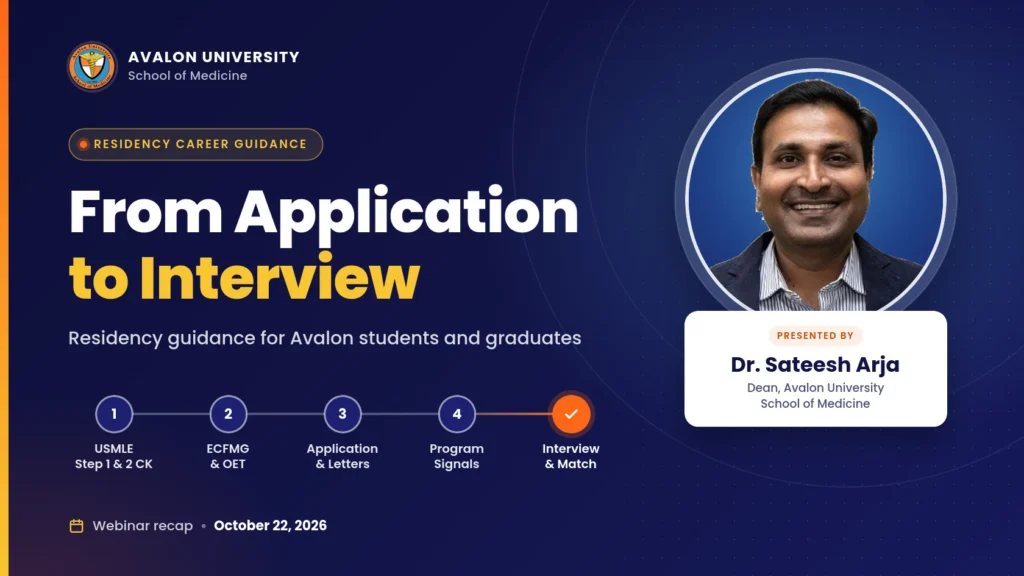
From Application to Interview: Residency Guidance for Avalon Students and Graduates
Highlights from Dr. Sateesh Arja’s October 22, 2026 residency career guidance webinar: exam timing, ECFMG and OET, specialty choice, program signals, and how to prepare for residency interviews.
 Avalon UniversitySchool of Medicine7 min read
On this page

Based on Avalon University School of Medicine’s residency career guidance webinar with Dr. Sateesh Arja on October 22, 2026. Statistics, policies, and deadlines below reflect what was presented in the webinar; applicants should verify current requirements with the relevant programs and official organizations.
The recording opens on GoToWebinar in a new tab.
A strong residency application has two jobs: earn an interview and make the most of it. Dr. Arja’s guidance connected exam timing, ECFMG certification, specialty choice, recommendation letters, program signals, and interview practice into one preparation plan. His central message was to make every part of the application tell a consistent, truthful story about the specialty you want to pursue—and then be ready to tell that story naturally in an interview.
What the 2026 Match numbers suggest
The webinar reported 53,373 registered applicants, 48,050 active applicants, 44,344 positions offered, and 41,482 positions filled in the 2026 Match. Dr. Arja described the overall fill rate as 93.5% and said Avalon had 54 residency placements and a 92% match rate. He also reported near-equal outcomes for Avalon’s US and non-US IMG graduates, citing approximately 80–90% for non-US IMGs and an example in which nine of ten Indian passport holders matched.
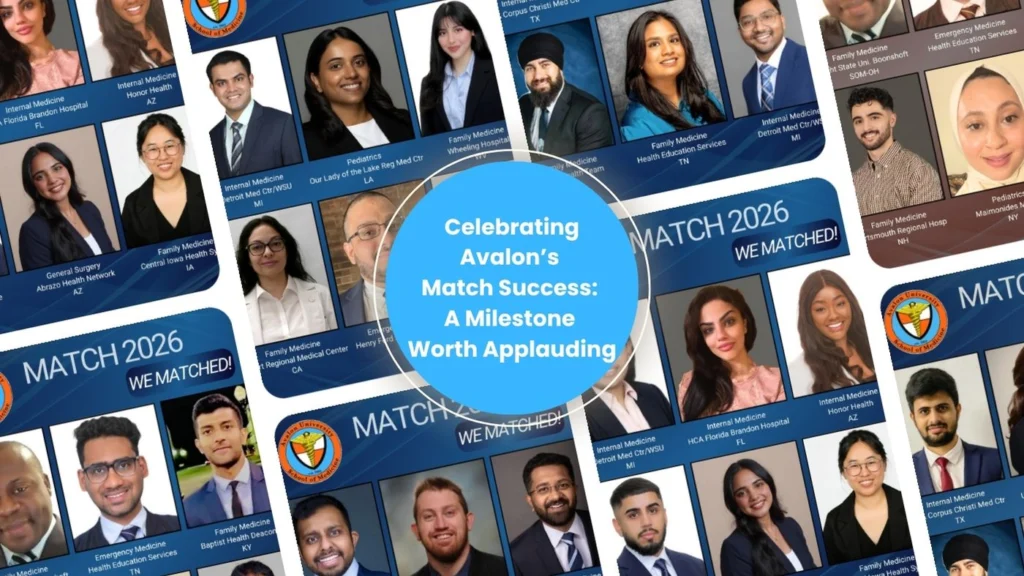
Dr. Arja contrasted those figures with reported national match rates of approximately 93.5% for US MD applicants, 93.2% for DO applicants, 70% for US IMGs, and 56.4% for non-US IMGs. In contrast to these national IMG match rates, Avalon had a 92% match rate. His point was not that any specialty is off-limits, but that applicants should use recent outcomes to choose programs realistically while showing sustained commitment to their preferred field.
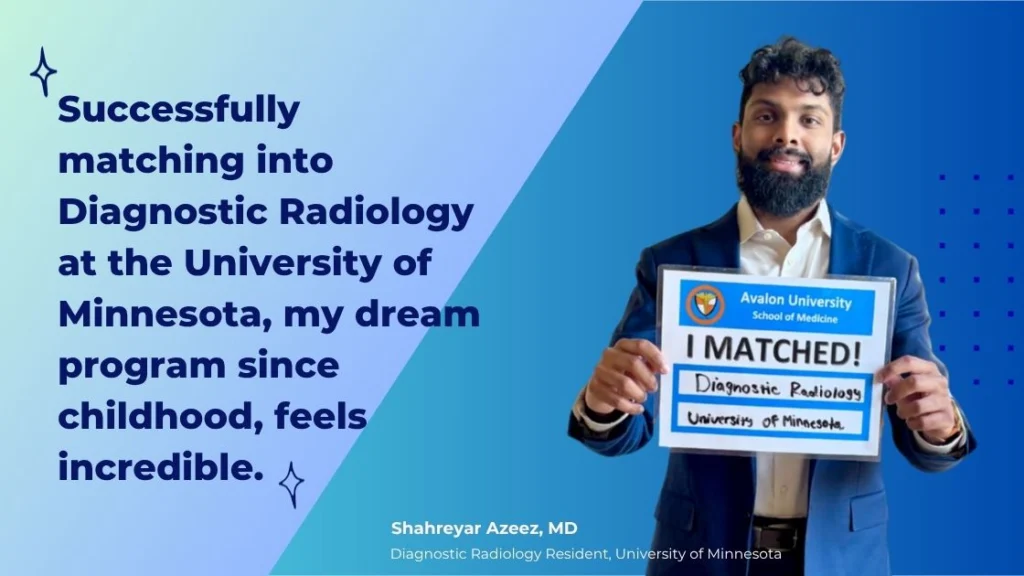
For US IMGs, he identified Internal Medicine, Family Medicine, Emergency Medicine, Pediatrics, and Psychiatry as the leading specialties. For non-US IMGs, he listed Internal Medicine, Family Medicine, Pediatrics, Psychiatry, and Neurology. He also noted that Avalon graduates are entering Surgery and that two are entering Diagnostic Radiology in 2026.
Qualify early—and leave time for results
Dr. Arja urged applicants not to treat exams and certification as last-minute tasks. He emphasized passing USMLE Step 1, taking Step 2 CK early enough for scores to reach programs while they are selecting interviewees, and completing the relevant ECFMG pathway and OET requirements. His recommended timing for Step 2 CK was October, if possible, and no later than the end of November; he considered December too late for many interview decisions. These were his planning recommendations, not a universal program deadline.
The webinar cited survey figures indicating that Step 2 CK is a major early application filter: Dr. Arja said 84% of programs required IMG applicants to have taken it for interview consideration, while 32% used a target score. He stressed aiming above a program’s minimum rather than treating an illustrative score, such as 235–245 for some Internal Medicine programs, as a guarantee. He also said a first-attempt Step 1 pass is strongly preferred, while reminding students that a failure does not automatically end a residency path.
For exam preparation, his advice was to master a manageable set of resources rather than continually switching. For Step 1, he discussed First Aid, Pathoma, UWorld or AMBOSS, Anki, NBME self-assessments, and Sketchy Microbiology. For Step 2 CK, he encouraged students to use OnlineMedEd alongside clinical rotations, plus a question bank such as UWorld or AMBOSS; he also mentioned specialty-specific resources. He recommended reviewing official USMLE sample questions and tutorials and considering a practice session at a Prometric center. Resource availability, exam formats, and testing arrangements should be checked against current official information.
ECFMG pathways and OET: check the current rules
Dr. Arja said Avalon graduates on or after January 1, 2024 should use Pathway 3, while earlier graduates should examine Pathway 6, which he described as requiring six patient encounters assessed by three licensed, board-certified physicians. He gave January 31, 2027 as the deadline for 2027-cycle pathway materials and said applicants should account for transcript, diploma, and other verification needs, not just exam completion. Because pathway eligibility and deadlines are consequential, applicants should confirm their own status and the current rules directly before applying.
He also said the OET is required regardless of an IMG applicant’s citizenship, giving minimum scores of 350 in Listening, Reading, and Speaking, and 300 in Writing. For the 2027 pathway, he said the OET test date needed to be after January 1, 2025. The webinar described both OET results and ECFMG certification as valid for two years; applicants should verify the precise rules that apply to their certification and Match cycle.
Build one coherent application
Dr. Arja repeatedly returned to the same test: Do the personal statement, experiences, clinical performance, letters of recommendation, MSPE, and interview answers support the same specialty choice? He encouraged students to choose recommendation writers in the specialty or a closely related subspecialty and to make sure the school knows about awards or honors that should appear in its Medical Student Performance Evaluation (MSPE) or Dean’s evaluation letter. He also highlighted specialty-relevant research, while noting that medical education research can add value across specialties.
For a personal statement, he proposed a concise four-part structure: an introduction to the path into medicine; a meaningful clinical experience that shaped specialty interest; what the applicant would bring to the field; and a forward-looking conclusion. His advice was to support claims of interest with experiences rather than simply declare enthusiasm.
Use program signals deliberately
The webinar emphasized signals as a tool for gaining interview consideration. Dr. Arja cited figures that 96% of programs used signals to help decide whom to interview and that 90% said signals could surface applications otherwise overlooked. Before assigning one, he advised checking the program’s visa policy, graduation-year limits, applicant profile, geography, and specialty fit. He cautioned against placing every signal in a single, highly competitive state and suggested reviewing Avalon’s published match list to identify programs that have previously accepted its graduates. Signal counts and tiers vary by specialty and cycle, so applicants should verify the allocation for their own application year.
Prepare for the interview, not a script
Dr. Arja described three broad kinds of residency interview questions: general questions about background and strengths; behavioral questions about past conflict, feedback, or difficulty; and situational questions about how an applicant would handle a future scenario. His preparation method was to draft bullet points for 15–20 common questions, practice them aloud and with others, and avoid sounding memorized. Avalon’s mock interviews were described as highly recommended rather than mandatory.
For “Tell me about yourself,” he suggested roughly two to three minutes, covering relevant family background, education, clinical rotations, and research or work experience. For “Why this specialty?” or “Why this program?” he advised choosing two or three specific reasons and grounding them in genuine experiences. A challenging-patient answer should explain the problem, how it was handled, and what was learned. Strengths likewise need evidence; an area for improvement needs an honest explanation of how the applicant is working on it.
Applicants should also prepare their own questions. Dr. Arja recommended six to eight across an interview day, with different questions for residents, faculty, and program leadership. His guidance was not to repeat questions or ask for information already plainly available on a program’s website. For virtual interviews, he emphasized clear audio, stable internet, suitable lighting and framing, and eye contact with the camera. Afterward, applicants should follow each program’s instructions about further communication, including whether a thank-you note is welcome.
The webinar’s distinction was that exam scores and application materials help secure interviews, while interpersonal skills and interview interactions weigh heavily in ranking discussions. Dr. Arja cited program-director figures of 89% for interpersonal skills, 84% for interview interactions, and 74% for resident feedback. In the Q&A, he said he did not think Step 2 CK would play a major role in rank order once an applicant had interviewed. That was his assessment; individual programs may weigh factors differently.
If the first Match does not work out
Dr. Arja urged unmatched applicants to prepare for SOAP, stay reachable, respond promptly, work with advisers, and tailor their approach to available programs while following the applicable rules. If still unmatched afterward, he suggested strengthening the next application cycle through additional clinical experience and research.
The practical takeaway
Start with a realistic specialty and program list. Finish exams and certification steps early enough that results and documents are available when needed. Build an application whose evidence consistently supports your specialty choice. Then practice explaining that evidence clearly, honestly, and naturally. Above all, verify the current official requirements and program-specific rules before acting on webinar figures or deadlines: the strongest plan is both well-prepared and up to date.
Watch the full webinar. Dr. Arja’s complete presentation and Q&A from October 22, 2026 are available as a recording.
The recording opens on GoToWebinar in a new tab.
Written by
About Avalon University
The Role of Ethics and Professionalism in Medical Practice
The Role of Ethics and Professionalism in Medical Practice: Imagine stepping into a doctor's office, vulnerabilities laid bare. Read more
Navigating the Path to Physician Licensure After Residency: Avalon University’s Commitment to Alumni Success
Physician Licensure After Residency: After years of rigorous medical education and demanding residency training, the journey to becoming...

Mastering Your Residency Match Journey: The Power of Mock Interviews
Residency interviews are a crucial part of the residency match process. They give programs a chance to get to know you beyond your...
Your path to an MD
Ready to start medical school?
Rolling admissions with three start dates a year. Explore our accredited programs or start your application today.